By Zehra Fatima (Team Research)
Surely, the recent Marvel movies must have you pondering about the possibility of the existence of a multiverse. Don’t worry, the multiverse theory isn’t just restricted to sci-fi movies because physicists themselves have thought about this, and there is indeed a chance for it to be true! There are various physical theories hinting at the existence of a multiverse; however, today we’re taking you with us to see what the already most mind-bending theory, i.e., quantum mechanics, has to say about this.
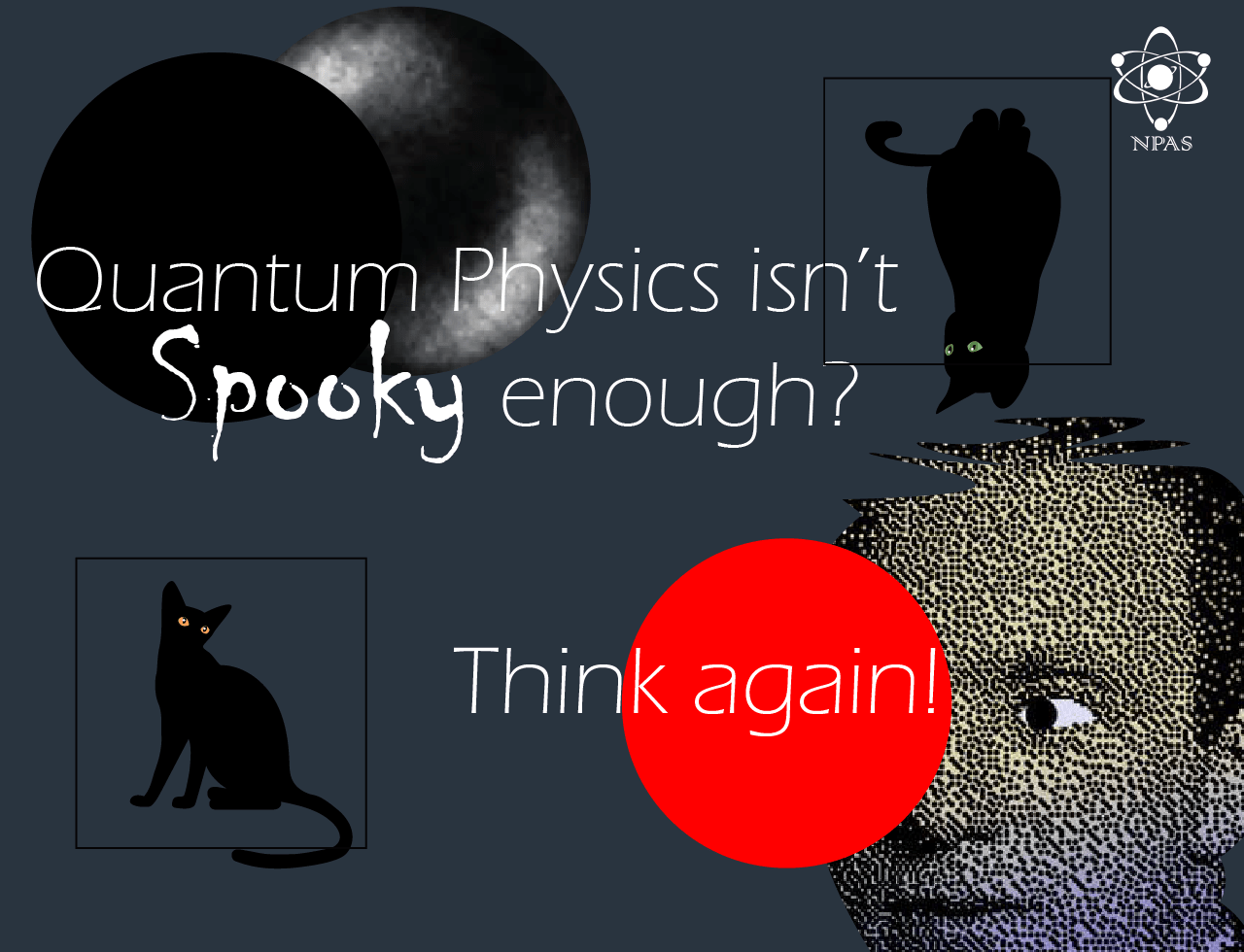
According to quantum mechanics a particle exists in multiple possible states, a phenomenon that is called ‘superposition’. This fancy term basically means that multiple states of a particle are described by a ‘wave function’ which assigns a certain probability to every possible state; however, an anomaly occurs when we observe the state of the particle. When we make an observation, we only ever see one of the possible states. So, the question is for you, reader, why are we only observing certain states and what happens to the other possible states of a particle?
To answer that, we need to tell you the story of a man named Hugh Everett, who took a rather unconventional approach towards this problem. In his mind, whenever a measurement occurs, the world splits or branches, a theory that led to his famous ‘Many Worlds’ Interpretation of Quantum Mechanics. In each world, he highlighted that we observe one of the possible states of a particle, and that every world is real. To picture this, think of the splitting of the world as the splitting of an embryo. Following this, Everett looked at the whole universe from a quantum mechanical lens, including the observers within it. He assigned a single wave function for the whole universe, essentially considering the whole universe as a single entity. Thus, whenever a quantum phenomenon occurs, which happens all around us by the way, the universe splits into different real universes.
The universes cannot interact with each other in any way. So, if you are planning on gambling money thinking you’ll definitely be rich in one of the possible branches, we’ll advise you not to do that because you don’t know which one, you’ll end up in! It won’t matter if in one universe you end up getting rich because that version of you does not interact with other versions of you who end up getting poor or worse. Therefore, as Everett taught us in the Many Worlds theory, we should act exactly as if we live in a ‘single-chancy’ universe.
Furthermore, this might make you wonder whether there exist infinite universes because there must have been large interactions among particles since Big Bang, but the answer is surprisingly a no. Considering there are about 10^88 particles within our observable universe, mostly photons and neutrinos, even if every particle interacted with other particle since the Big Bang, there should be about 110^112[1] branched universes, which is a large but nevertheless finite number of universes!
Another question that you might be thinking of right now, why do we not feel ourselves splitting or branching? While we don’t have an explicit explanation for this right now, think of it like the rotation of the Earth, we don’t feel it happening but that does not mean it isn’t occurring.
One of the major problems is that as of now, we have no real way of proving the Many Worlds theory as the branched universes cannot interact with each other in any way at all. Nonetheless, this should not deter us from the fact that this theory is the only one of its kind which is the most consistent with the universe as we see it through Quantum Mechanics. Therefore, if you consider yourself a true believer in Quantum Mechanics, this theory is certainly the one for you!

This is the most straight forward and pure quantum mechanical explanation of the ‘measurement problem’ as it simply explains the world in terms of the Schrodinger Equation. As Ted Bunn so bluntly puts it, every non-Everettian theory is just a disappearing world theory. Keeping that in mind, one comes to an amusing realization; there might actually be an evil Einstein in an alternate universe who believes God does play dice with the universe.
References
[1] Something Deeply Hidden by Sean Caroll
[2] Six Impossible Things by John Gribbin

 npasofficial.com
Good job
LikeLike