By Talha Tariq
The most puzzling question about our universe is about how it came into being. Scientists and experimental data suggest that the universe originated from nothing; yes, literally from nothing. At first thought, this explanation might seem illogical, but trust me – there is a strong mathematical and experimental proof for it. But again, how can something originate from nothing? To answer this, let me take you on a journey from the macroscopic to microscopic world.
Sensible, predictable, and understandable. That’s how our macroscopic, classical world is like; or at least that’s how we like to see it. But the microscopic world is very different. With its inherent uncertainty, it is very difficult to predict what’s going to happen in a quantum system. According to the quantum mechanical description, everything in the universe is the physical manifestation of this uncertainty principle, first introduced by a German Physicist, Werner Heisenberg. In mathematical notation it states,
ΔxΔp ≥ h / (4*pi)
In simple words, this relation states that in the microscopic world of electrons, photons, etc, we cannot precisely measure position and momentum of a particle, unlike our macroscopic world where one can exactly measure the position and momentum of an object; for instance, a car. But this is not merely an experimental limitation, as most people think, but rather an inherent property of a quantum system.
A simple case would be a single atom of hydrogen with a nucleus of 1 proton and 1 electron revolving around it, as two particle are oppositely charged they are supposed to attract each other, and ultimately form a single body, but when the electron gets too close to the nucleus, its position in space is precisely known, thus error in measurement of its position is almost zero, and which as explained by the uncertainty principle, implies that error in measuring its momentum (velocity) would be enormous. In that case, the electron could be moving fast enough to fly out of the atom altogether. So, due to restriction implied by the uncertainty principle, atoms don’t implode, and we human and everything around us exists.
But this is just the start of a beautiful story of how the universe came into being, but before we proceed, let me remind you of something that you learned in your primary education: an arithmetic rule for integers which implies that
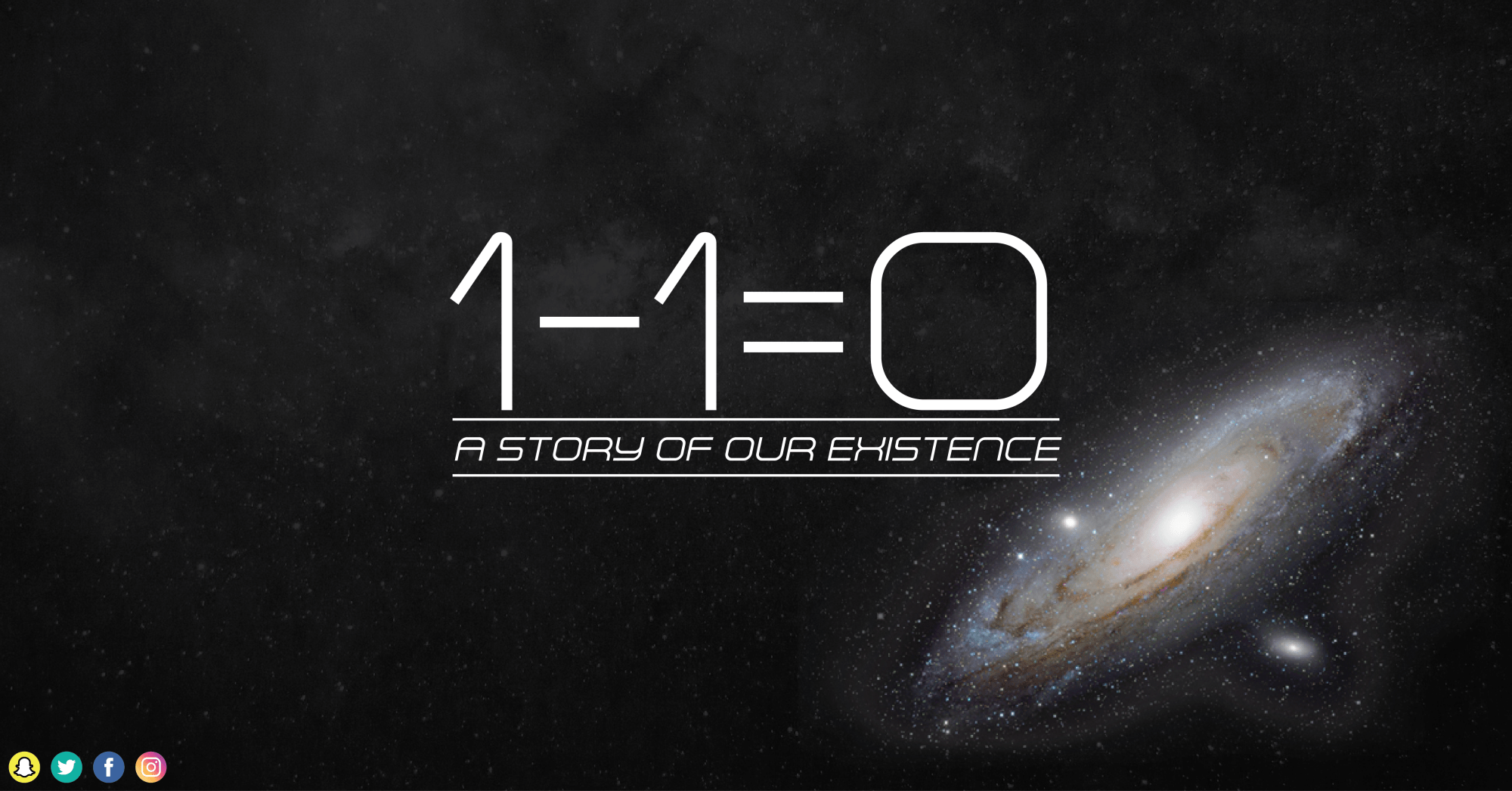
1-1 = 0
The above equation is not just an ordinary equation. In fact, it is the equation of our very existence. The zero on the right hand side depicts nothingness, while 1 and negative 1 sum up to nothing. But individually, they have very real existence, just likes ours. So, to be or not to be depends on how you see it.
Let’s see how this idea generates from the principle of uncertainty. For this purpose, we will need a concept from relativity introduced by Albert Einstein, which says that we live in not three, but four dimensions, named as space-time. So, to understand our existence, we need to introduce the concept of space-time in quantum mechanics. In special relativity, we put space and time on equal footing and say that they are part of a single mathematical object called the “four-vector” (T, x, y, z). Other relationships of this kind also exist; for instance, between charge density and current density, but specific to our interest is the relationship between energy and momentum (E, px, py, pz). We can say that an uncertainty relation just like between position and momentum, should hold for energy and time .
ΔE ΔT ≥ h /(4*pi)
Note that there is a mathematically more sound way of deriving this formula.
This formula tells us the most fascinating story ever! It says that if we examine a very small volume of space, we could – in principle – know precisely how much energy it contains. In the absence of any material particle, or any form of energy in small volume of space-time, we get a quantum vacuum. And now, if we look at it for a very short interval of time, we will lose the ability to know exactly the amount of energy present there implied by energy-time uncertainty. Things get more interesting when we try to examine an even smaller volume of space over an even smaller time interval. Something strange happens in this space-time volume; the amount of energy becomes so uncertain that there is a non-zero probability that it could contain enough energy to create particle and anti-particle pair out of nowhere. Most of the time, these particles annihilate each other just like in our equation of existence, but individually, each particle is just as real as you are. So, something can come from nothing, according to the quantum mechanical description of the world. This is not a farfetched story. There are experimental observations of this phenomenon known as “quantum fluctuations”.
There is a more fascinating way of seeing this idea and the effect of quantum fluctuations rather than in a very small space-time volume: the Big Bang theory, which explains how our universe came into being nearly 14 billion years ago out of nothing. Tiny quantum fluctuations suddenly produced enough energy that led to the rapid expansion of space and mass. That then continued to grow and develop into the stars, galaxies, and everything else we see around us today. This strange fact is the profound connection between our infinite universe and nothingness from which it originated.

 npasofficial.com
Extraordinary to present such a delicate topic in a way that everybody can comprehend.
LikeLiked by 1 person