
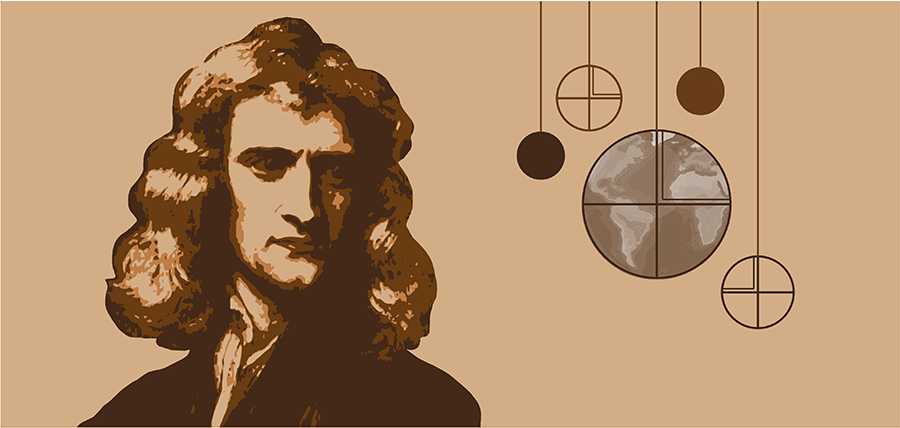
By Nowsherwan Khan (Research Team)
The Malus Intrigue
“Everybody is special.” We all hear this in our lives a lot, in fact. What makes a human so special? It’s their ability to be adept at something that others are not.
For example, someone might be great at football in their neighborhood and become special in terms of football. This is something natural as God has given abilities to everyone in one way or the other.
The thing that really differentiates the greatest from the greats is “unrelenting passion.” Now, this unrelenting passion is something that is found only in very special kids in childhood. A child learns the fastest in their early days, but the majority get distracted due to various reasons.
There are a few kids in human history who have proved to be “the special ones.” Right from their childhood, their mind, their way of approaching something, their thinking and questioning power, was really out of this world. And above all those special kids stands the greatest! The one that changed the course of the scientific revolution.
A Boy Like No Other
Imagine growing up in a place where all you have to do is count your sheep and make sure they are safe, just because they are the source of your livelihood. The moment you lose your sheep is the moment you lose your livelihood.
Well, of course, everyone has to follow this if they are growing up in such a place because they have no other choice.
But there was one special kid who challenged his people’s rustic thinking. He hated counting sheep and never cared if they were alive, lost, or dead.
His name was Isaac Newton. The man ranked second in “100 Most Influential Men in Human History.” Right from his childhood, Sir Isaac had a different mind and way of thinking than any other kid his age.
Raising sheep was something he hated the most. Instead, he would love to read books that were on the shelves in his home where he lived with his mother and grandparents.
In his childhood, he asked a question that was rarely asked by the greatest scientists before him: Do the heavenly bodies like the sun, moon, and stars also work on the same rules and principles as the ones that work down here (on earth)?
He saw patterns in the rising and setting of the sun. He used to make tiny windmills, water clocks, and sundials and checked how the sun and wind made them work! This is not something a child thinks about, but Sir Isaac did.
There was a belief that the sun, moon, and stars orbit around the earth, and no one dared to challenge this. So, Isaac had to study his own people’s beliefs first. Therefore, he was getting into deep research right when he was around 15.
But as he grew to manhood, he did dare to question this belief that the sun, moon, and stars orbit around the earth.
Isaac was not someone mentally well either. His father had died before his birth and his mom married another man and left with him, so Isaac was left all alone with his grandmother.
Isaac hated his mom and her husband so much that he threatened to burn them in their own house. He had a few friends and literally nothing else to do other than ponder on the secrets of the cosmos!
Most people would start with elementary science, but Sir Isaac first worked on “how will I prove that all the heavenly bodies and earth work on the same simple, elegant principles?”
Here is a small glimpse of his extraordinary thinking:
Once a very fast wind came in England while Isaac was sitting on a bench. His fellow students started running and saying “Who will protect us?” because it was the time of a political crisis and people had many strange beliefs.
They thought that when a very fast wind comes, it means the end of the king (at that time). But Isaac never cared what happened to the kingdom or him. He went straight out to the wind.
First, he jumped along with the wind, then into the wind, over and over. He was tracking his jump’s length. Then he measured that some of his jumps were of a higher length while others were shorter.
If you are in high school, you would clearly know that he had felt a glimpse of something we call force. But we never thought about this as kids. But young Isaac did and he did very well.
Isaac was born in 1642 and his years 1665-1667 are known as the Anni Mirabiles, his miraculous years. In these two years, he made inventions, unpublished, that were never done by any other scientist. It is said that these two years are the most productive years that any human has spent.
He created the Generalized Binomial Theorem.
He gave us Fluxions, which are called differential calculus.
He gave us inverse fluxions – integral calculus.
He gave us the laws of motion.
He gave us optics.
All of this only in the course of two years! Imagine someone inventing modern science at the age of 23. He had not published any of these because he never cared about it! All he cared about was working and knowing the principles that governed the earth and other celestial bodies.
His passion for learning was so great that he stuck a bodkin in his eyes just to see the effects of light! He used a mirror to look into the sun until he could not see anymore, and then he would look in the dark corners of his room where he would see mixed colors like purple, blue, and red.
Now, we all know no one is ready to do this! But young Isaac had to because he had an extreme passion for it. It was due to these efforts that he finally proved that light is a spectrum of seven colors. Now this was very hard to digest for many, many scientists. They had already agreed that light was not a spectrum of many colors.
When he was asked how he ever did all this, he answered “I just continuously thought upon these matters.”
There are reports of his colleagues going by his room and finding Newton sitting and writing complex mathematics, working on his theories. They would come by at night and find Newton still sitting and working. They would come by in the morning and find Newton still sitting and working. This is what actually differentiates him from normal humans. He had this desire to actually do something unbelievable, and he has done it.
In 1669, he became the Lucasian Professor of Mathematics at Cambridge, the most prestigious chair of mathematics. At a very young age, he had achieved such greatness. How did he become the Lucasian Professor? Well, the person before Newton who was the Lucasian Professor was Isaac Barrow. He was a mentor to the young Newton and he knew this guy was something else, so he recommended Newton.
He used to give lectures but few people would attend. Imagine bunking from class with one of the most genius guys ever born?
Reflecting Telescope
In 1671, Newton invented the reflecting telescope and he sent it to the London Royal Society. The telescope was a masterpiece, and the Royal Society asked Newton to become a member.
This was the first time he actually published something or showed his work. Then the Royal Society encouraged him to send more of his works and Newton sent some of his research papers on optics, but it received a lot of criticism.
The main critic was Robert Hook, the one we know from Hook’s Law. Newton wanted to resign from the Royal Society, but eventually, he did not and in the future, he was actually the head of the Royal Society for decades.
Rivarly with Leibnitz
The rivalry between Newton and Leibnitz is well known. We have all heard the story of the apple falling on Newton’s head, but did the apple really fall on Newton’s head? No, actually Newton had seen an apple falling just like everyone else and he asked the simple question: If the apple falls, does the moon also fall? This question led him to discover the greatest or most influential branch of science – calculus.
The famous branch of mathematics called calculus was invented independently by Newton and Leibnitz, and there has been tension about who did it first, or whether one copied from the other.
At first, Newton and Leibnitz had no problems and they would write letters to each other sharing their mathematical works. For example, Newton would send him the generalized binomial theorem and then Leibnitz would share some of his works with Newton.
Newton first started with differential calculus and Leibnitz first started with integral calculus. But some say that Leibnitz copied the idea from Newton’s notes when they met. Until now, there is no 100% proof of who did it first or how it was done, but one thing is certain – both of them gave us the gem of mathematical branches – calculus.
The Bernoullis, who were important in the field of science, were actually on Leibnitz’s side in this “war.” Once Johan Bernoulli challenged the mathematical community with a challenge known as the “Brachistochrone.” In this, it was required to find the fastest path for a particle to move under its own weight. The fastest path means the path in which the particle will travel the fastest under its own weight. Johan did not want straight lines to be sent as the solution. A straight line is the shortest distance between two points, but it is not the path where the particle will have to travel the fastest under its own weight. Johan gave the mathematical community one year to solve the problem. By the end of that year, he only received one answer from Leibnitz. Leibnitz also said that Johan did not give enough time to solve the problem, so he should extend the time.
Johan did extend the time, but he also wrote an indirect attack on Newton in the question. He said that people who said they had found this new method of fluxions (differentials) had not yet solved the problem, even though that method was invented long before them by others. Johan then took a copy of that journal and mailed it to Newton so he would not miss the point.
Newton was with his niece in London and he came back from the tower at 4 in the evening, very tired. His niece handed him the letter and he learned about the problem. Newton did not sleep until 4 in the morning and he solved the problem! He sent the solution to Johan Bernoulli but did not write his name, so it was an anonymous letter from London to Bernoulli in which the problem was solved.
By the end of Easter, Johan received five solutions: one from his brother, one from himself, one from Leibnitz, one from L’Hopital, and one written by an unknown person from London. Johan praised Newton on this and said “I recognize the lion by his paw.”
The Greatest Book of All Time
Principia Mathematica is considered the greatest book ever written on science to date. It covers the principles that govern celestial bodies, including explanations of gravity and the laws of motion. Newton’s work in this book laid the foundation for classical mechanics and had a profound impact on the world of science, leading to the development of numerous machines based on these fundamental principles.
In addition to Principia Mathematica, Newton made many other significant contributions to science and mathematics, including the laws of motion, the reflecting telescope, the binomial theorem, calculus, the law of viscosity, the law of cooling, and the inverse square law. These discoveries cemented his reputation as one of the greatest physicists and mathematicians of all time. It is said that minds like Newton’s only come around once in a thousand years.

 npasofficial.com