By Maryam Ahsan
On December 25, 2021, the world held its breath as a landmark event began to unfold, opening a new chapter in humanity’s quest to explore the universe. The James Webb Space Telescope (JWST) – result of a collaborative effort between NASA, the European Space Agency (ESA), and the Canadian Space Agency (CSA) – was launched into space, marking the culmination of a decade-long effort by hundreds of engineers.
As the most powerful space telescope ever constructed continues its 29-day journey to its final destination at the second Lagrange point (L2), let’s dive into the necessity of a space-based observatory, the historical journey of humanity’s quest to probe deeper into the cosmos, the advancements JWST brings over its predecessors, and the physics behind looking farther into the universe.
The Need for a Telescope in Space
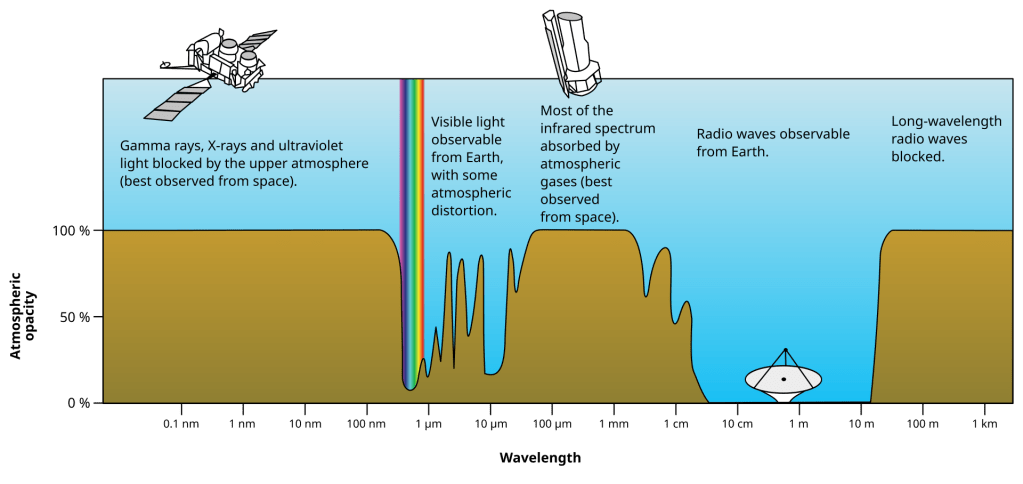
Telescopes have been humanity’s eyes to the cosmos, enabling us to explore celestial phenomena far beyond the capabilities of our unaided vision. However, observing the universe from the Earth’s surface comes with significant limitations. The Earth’s atmosphere distorts and absorbs various wavelengths of light, especially in the infrared spectrum, where many cosmic phenomena emit their radiation. Additionally, light pollution and weather conditions further obstruct the view.
To overcome these limitations, astronomers and engineers have long sought to place telescopes in space, above the Earth’s atmosphere. A space-based telescope can capture clearer and more detailed images across a broader range of wavelengths, allowing scientists to observe phenomena that would otherwise be invisible from the ground.
A Brief History of Humanity’s Cosmic Quest
Humanity’s fascination with the night sky dates back millennia as studying it has allowed humans to navigate land and sea, mark the beginning of seasons, and achieve groundbreaking scientific advancements. For instance, Albert Einstein’s motivation for developing General Relativity was partly driven by the need to resolve the anomalous precession of Mercury’s orbit observed by astronomers.
Ancient Arab astronomers, such as Al-Battani and Ibn al-Haytham, made significant contributions by advancing observational techniques and developing early star catalogues. The invention of the optical telescope by Hans Lippershey in 1608 marked a pivotal moment in this quest. It enabled astronomers like Galileo Galilei to observe the moons of Jupiter and the phases of Venus, challenging the geocentric view of the universe.
In the centuries that followed, increasingly powerful telescopes were developed, culminating most notably in the launch of the Hubble Space Telescope in 1990. Hubble, orbiting above the Earth’s atmosphere, provided unprecedented views of the cosmos, capturing iconic images such as the Pillars of Creation and the Deep Field, which revealed thousands of galaxies in a tiny patch of sky.
James Webb Space Telescope: A Quantum Leap Forward
While Hubble has been an extraordinary success, it is limited in its ability to observe the universe in the infrared spectrum, where many of the earliest and most distant objects emit their light. The James Webb Space Telescope, a joint effort between NASA, ESA, and CSA, was designed to address this limitation.
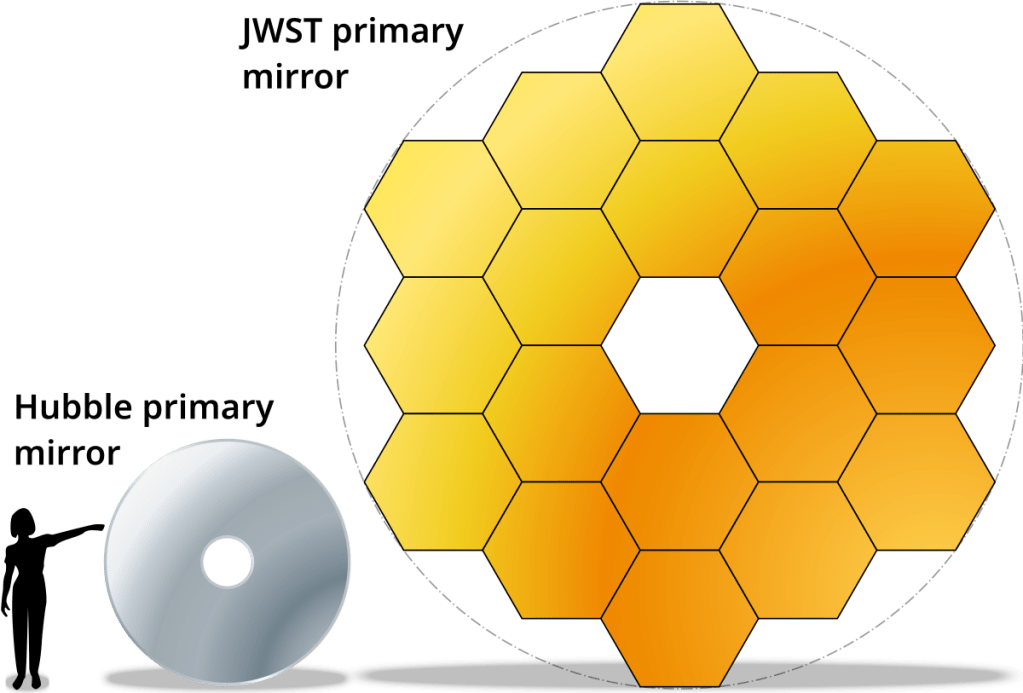
JWST is an infrared-optimized telescope with a 6.5-meter primary mirror, more than twice the size of Hubble’s. This larger mirror allows JWST to collect more light, enabling it to see farther back in time and observe fainter objects. The telescope is equipped with advanced instruments capable of studying the formation of stars and planets, the atmospheres of exoplanets, and the first galaxies that formed after the Big Bang.
One of the most significant innovations of JWST is its location. Unlike Hubble, which orbits the Earth, JWST will be positioned at the second Lagrange point (L2), about 1.5 million kilometers from Earth. This location provides a stable environment with minimal interference from Earth’s heat and light, allowing for more sensitive observations in the infrared.
Looking Farther into the Universe and What to Expect
When we observe distant objects in space, we are seeing them as they were in the past because light takes time to travel across vast distances. For instance, light from the Sun takes about 8 minutes to reach Earth, so we see the Sun as it was 8 minutes ago. The farther an object is, the longer its light has taken to reach us, meaning we are observing it as it existed in the distant past. This concept allows astronomers to look back in time and study galaxies, stars, and other cosmic phenomena as they appeared billions of years ago.
As the universe expands, light from distant objects is stretched into longer wavelengths—a phenomenon known as redshift. The most distant objects are so redshifted that their light has moved out of the visible spectrum and into the infrared. JWST’s ability to observe in the infrared enables it to detect these ancient, redshifted objects, providing a glimpse into the universe’s earliest epochs.
JWST can detect objects up to 100 times fainter than Hubble, reaching back to a redshift of approximately z≈20 (180 million years after the Big Bang) while the earliest stars are thought to have formed between redshifts z≈30 and z≈20 (100–180 million years after the Big Bang), and the first galaxies may have appeared around redshift z≈15 (270 million years after the Big Bang). Therefore, JWST is poised to address some of the most profound questions in astrophysics. It will enable us to explore the formation of the first galaxies, peer into the dense clouds where stars and planetary systems are born, and analyze the atmospheres of exoplanets for potential signs of life – ushering in a new era of science exploration and deepening our understanding of the universe in ways we can only begin to imagine.
While we await data from the JWST, you can find more details on its construction and timeline on NASA’s official JWST webpage. Additionally, you can look at its deployment over the course of its 29-day journey to its final destination at the second Lagrange point (L2) here.

 npasofficial.com