
By Musawwir Ahmed – Team Publications
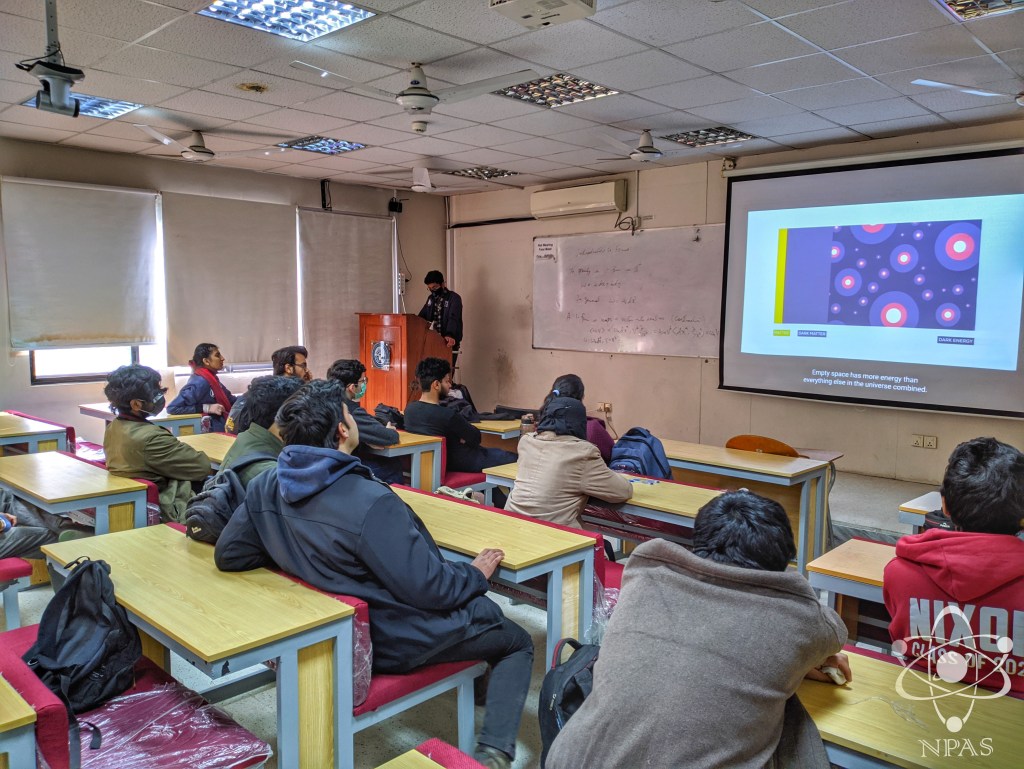
The discussion commenced with the mediator floating the question, “Are you familiar with Dark Matter?” and asking ideas regarding the nature of dark matter. A number of people raised hands in affirmation, and for those who didn’t (and those of you who might be in the dark) a brief introduction was provided by the former audience members – the gist of which is presented below,
“A number of observations and experimental data show that certain effects like acceleration of universe, expansion rate of universe, rotation of galaxies, etc. cannot be explained by accepted theories of gravity unless more matter is present than can be seen. This is where Dark Matter comes into play, its one of the many efforts put in by Physicists’ to explain these phenomena. Experts believe Dark Matter to present in abundance in the universe. It has been named so because it does not appear to interact with the Electromagnetic field, which means it does not absorb, reflect or emit Electromagnetic Radiation, and is therefore difficult to detect.”
The subject soon took a turn to theoretical physics and the historical background within which the idea of dark matter was proposed. Gravity, it was said, is 10-43 times weak compared to the nuclear forces. The cosmological constant is only a feature of General Relativity (GR), introduced by Einstein, which he called his biggest blunder. Although the cosmological constant is based on the assumption that the universe is static, it is a vital part of GR; GR has had ready application in GPS and it has been tested many times, passing each test with an ever-greater accuracy. The theory of Quantum Mechanics does not have the cosmological constant – Heisenberg’s principle introduced the cosmological constant, due to this Quantum Mechanics is fundamentally uncertain.
A freshman uninitiated in Quantum Mechanics, asked the logic behind the Heisenberg’s principle. The mediator stepped in and Kurzgesagt’s video on dark matter and energy was played – which summarized our current knowledge regarding Dark Matter and which theories Physicists’ are currently looking into. A final year BS Physics students quoted a paper published in early 2021 on Modified Newtonian Dynamics. Modified Newtonian Dynamics proposes that perhaps there is a need to modify the existing Newtonian dynamics, and the modified version leads to no need for dark matter to explain the “missing mass conundrum”. At this point, a third year BS Physics student interjected, and considered it an affront to general relativity, rejoinders citing all the merits of general relativity and how the ideas it presented such as black holes (gravitational waves too) were proven right; and how it had ready application in the fields of satellite tracking and GPS. He further cited ideas that were directly introduced by GR, such as holograms and information theory. He concluded the argument on the fact that all the predictions of GR have been confirmed; further quoting that the orbit of Mercury was a major question in Physics and the orbit of Mercury as calculated by GR came out to be within 0.002% of the actual value.
A stay observation was made at this point that GR is leading the scientists closer to QM; though no statement backing this was put forward. The proponents of modified Newtonian Dynamics made the point that there are not very many laws but theories in Physics and there is always room for advances and maybe we could even reduce the 0.002% error; further establishing that Standard Model is an incomplete theory although its results are accurate up to 11 decimal places. The third year student, armed with his knowledge on the history of Physics discussed how Galileo made his mark concluding on a fact that may be said to have more aesthetic value: GR is the world of order and QM is chaos. He gave quite a decided opinion deeming it problematic to modify a theory that perfectly predicts something. The mediator stepped in, reconciling the differing opinions saying, “GR is true but it must be a subset of a theory that maps onto reality more perfectly and perhaps it is needed to expand the scope of GR, just how Maxwell’s equations did in electrodynamics”.

A fourth year student remarked that in their studies of Quantum Field Theory, they literally changed a sign in calculations from + to — just to conform to experimental results and scientists have spent 50 years trying to figure that out. The mediator gave a decided opinion on the foregoing saying that the fundaments in physics can never be wrong and made a few remarks :Maxwell’s equations rejected Galilean physics; so a theory that simplifies to the existing theories in specific cases is needed. The mediator presents an astounding fact that, if the Schrodinger’s equation wasn’t already sufficiently complex, it too is a specific simplification of Einstein’s field equations. He further pointed that perhaps for the time being there should at least be the acknowledgement that Maxwell’s equations haven’t still been proven wrong and that nothing is set in stone. Another student further built on the point saying that we need a technological leap because experiments do have limitations. She further brought the attention to a novel idea of an ‘anti-Higgs field’ (so to speak), explaining it as, “Could there be an anti-Higgs fields that is perhaps taking away the mass making them (Dark Matter particles, famously dubbed as WIMPS (Weakly Interacting Mass Particles))? Just as the Higgs-Field endows mass to paeticles in the matter-part of the universe?” The question sparked an interest in the audience and somebody made a stray observation that, “Even nothingness has vibrations”.
At this point, due to shortage of time, the talk had to be concluded leaving the audience on the edges of their seats until next time…

 npasofficial.com