By Hamza Ali – Team Research
Navigating Through the Messiness of Climate Change
The big picture of climate change is straightforward enough: Heat-trapping gases in the atmosphere are turning Earth into a metaphorical greenhouse, making the planet warm.
But exactly how that warming will occur — across the planet’s oceans, ice caps, mountains, forests, and cities, fueled by everything from methane leaks to carbon dioxide to hydrofluorocarbons — is extraordinarily messy.
The physics laureates found ways to account for the roiling randomness present in everything from materials to the motion of the atmosphere, and still make useful predictions.
The Nobel Prize committees have recognized the global challenge of climate change before. The 2007 Nobel Peace Prize was awarded to former US Vice President Al Gore and the Intergovernmental Panel on Climate Change, a global group of leading climate scientists convened by the United Nations. The 2018 economics prize was shared by William Nordhaus, who developed a model that integrated physical climate models and economics, quantifying the social impacts of warming.
Now climate modeling is getting a turn in the spotlight. Figuring out exactly how the planet will warm up, is urgent: It will shape where crops can grow, where people can live, and what the rising onslaught of disasters will cost. These scientists, and the stark future they helped to illuminate, are still shaping humanity’s efforts to avert a global catastrophe.
HISTORY OF CLIMATE SCIENCES
Climate science has rapidly advanced in recent years, but the foundations were laid hundreds of years ago and predate the Nobel Prizes, which were first awarded in 1901.
In the 1820s, French scientist Joseph Fourier theorized that the Earth must have some way of retaining heat and that the atmosphere may play some role. In 1850, American scientist Eunice Newton Foote put thermometers in glass tubes and experimented with placing them in sunlight. Inside the tubes, Foote compared dry air, moist air, and carbon dioxide, and found that the tube containing CO2 warmed up more than the others and stayed hotter longer.
In 1859, Irish scientist John Tyndall began quantifying how much heat different gases in the atmosphere absorb. “As a dam built across a river causes a local deepening of the stream, so our atmosphere, thrown as a barrier across the terrestrial rays, produces a local heightening of the temperature at the Earth’s surface,” Tyndall wrote.
And in 1896, Swedish scientist Svante Arrhenius calculated how much carbon dioxide warms the planet and in his later work theorized that more carbon dioxide in the atmosphere would cause the planet to heat up.
But figuring out how these larger trends play out on smaller, more tangible scales proved complicated. How much a given region would warm up with more greenhouse gas emissions hinges on local conditions like tree cover, air pollution, wind patterns, and rainfall in addition to how much heat the atmosphere can trap.
THE NOBEL LAUREATES’ WORK
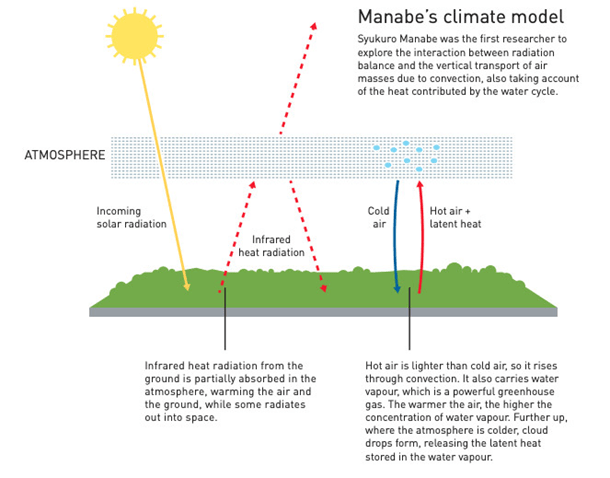
As a meteorologist for the US government and at Princeton in the 1960s, Syukuro Manabe connected energy absorbed by the atmosphere to the movement of air vertically over the Earth, a critical parameter for simulating the climate.
At the Max Planck Institute for Meteorology in the 1980s, Klaus Hasselmann worked to connect rambunctious, short-term weather patterns with long-term shifts in the climate. He found that even noisy weather data could yield insight into broader patterns, and even allow scientists to trace human influence on the climate. These findings planted some of the earliest seeds of climate attribution science, which scientists now use to quantify just how much humans have worsened a given heat wave or torrential downpour.
Giorgio Parisi’s work wasn’t inherently linked to climate systems, but his research in the 1980s proved that the seemingly random movements of particles could be quantified into patterns and predictions. This insight helped climate scientists build simulations up from individual gas molecules.
In the decades since this early work, climate models have grown more sophisticated, and computing power has started to catch up. It has given researchers a clear vision of the future should greenhouse gases continue surging in the sky.
But the greatest uncertainty in climate forecasts remains what humanity will do — whether countries, corporations, and individuals will choose to cut their harmful emissions rapidly and drastically. And that remains, as scientists say, an area of active research.
Combined, the work of Manabe, Hasselman and Parisi has enabled scientists to predict how the chaotic, coupled behavior of the atmosphere, oceans and land surfaces will change over time. While detailed long-range weather forecasts are not possible, humanity’s ability to understand this complicated system is an incredible achievement. Manabe, Hasselman and Parisi are richly deserving of the Nobel Prize in Physics. It’s up to us now to solve the problem that Hasselman, Manabe, and Parisi helped the world understand.

 npasofficial.com
One thought on “Nobel Prize in Physics 2021 (Part 2)”