By Hamza Ali – Team Research
Humanity is constantly pushing the boundaries of research in different fields of science. Many individuals dedicate their lives to such researches, and the Nobel Prize in Physics serves to recognize their efforts and show the world that there is still too much to be researched and discovered in the realm of physics.
Every year, a Nobel Prize in Physics is awarded to commemorate the ground breaking findings of scientists in physics, astronomy and other related areas of research. There were many worthy contenders for this award this year as well, each contributing to humankind’s advancement.
LOOKING AT Possible NOMINEES for Nobel Prize in Physics 2021
There’s a buzz around quantum information technology these days, with many experts predicting that the field is on the cusp of big and exciting developments. It could mean that a quantum computer finally solves a real-world problem faster than a conventional computer ever could. But the concept behind this emerging technology could also lead to more sensitive medical and diagnostic tools or more widespread and secure communication networks.
One possible nomination for a Nobel Prize in Physics could have been an international trio of scientists: Alain Aspect, John Clauser and Anton Zeilinger. The three physicists pioneered early experiments that showed quantum particles can be linked, or entangled, such that the random behavior of one is tied to that of the others much more strongly than it seems to be intuitively possible. Quantum entanglement lies at the heart of many of the latest quantum tech advances.
Other deserving quantum researchers who could have won the Nobel Prize include Peter Shor (a mathematician who in 1994 showed how a quantum computer might break a standard encryption method), and Gilles Brassard and Charles Bennett (mathematicians who researched on quantum-based encryption might help save the day an encryption-breaking quantum computer ever comes to pass.)
A chunk of gold displays certain iconic properties, including its shininess and golden hue. But it turns out that these traits can be changed. If scientists arrange the atoms of gold in special patterns, they can make the metal look red or green or otherwise make it interact with light in such ways that don’t happen in nature. The gold becomes an example of a metamaterial – a material with unusual and artificially designed properties.
The Nobel Prize this year may have recognized leaders from the field of metamaterials. One of the top candidates was John Pendry, who proposed that metamaterials could make real-life “invisibility cloaks.”
But the potential uses for metamaterials go far beyond such Harry Potter-like applications. They may help further miniaturize electrical and optical devices, for example, or enable engineers to devise more efficient ways to harvest energy from the sun. Metamaterials could also interact with sound or heat in seemingly impossible ways.
David Smith was another top contender for his metamaterials research. One of his first papers on the subject in 2000 was initially rejected from the journal Physical Review Letters, he said, with the editors writing that it did not seem important enough to publish. Much has changed in the ensuing decades.
A potential winner could also have been Lene Hau, a leading physicist whose teams have slowed light to about 40 mph, and even stopped it completely. The process involves gases of supercold sodium atoms and a couple of lasers, one that sends a light pulse through the gas while the other one controls the way the gas interacts with the light. In one case, the researchers were able to halt the light and store the information it possessed in the sodium atoms. Later, they could convert the information back to light.
The ability to transfer information from light to matter and back again, could also be useful in the aforementioned field of quantum information technology.
AND THE PRIZE GOES TO…
While these contributions were significant, three scientists who began to cut through the chaos of the global climate, laying the foundation for forecasts about the future of the planet, were considered most worthy of the 2021 Nobel Prize in Physics.
The Nobel Prize in Physics in 2021 was awarded to Syukuro Manabe, Klaus Hasselmann, Giorgio Parisi for the physical modelling of Earth’s climate, quantifying variability and reliably predicting global warming and for the discovery of interplay of disorder and fluctuations in physical systems from atomic to planetary scales.
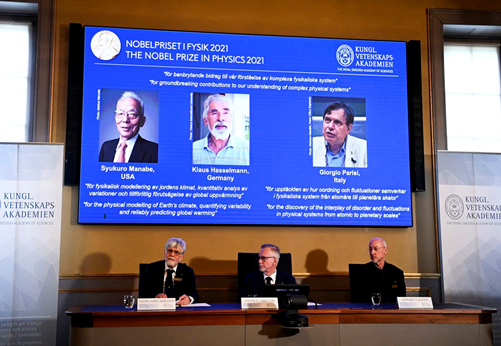
Half of the $1.1 million prize was awarded to Giorgio Parisi, 73, of Sapienza University in Italy, for his work quantifying randomness and connecting the movement of atoms to the planet as a whole. The other half was split evenly between Syukuro Manabe, 90, of Princeton University, and Klaus Hasselmann, 89, of the Max Planck Institute for Meteorology in Germany. Manabe and Hasselmann developed models that could make reliable forecasts despite the inherent volatility of the planet’s climate system.
(Read the remaining in Part 2)

 npasofficial.com