By Ramish Saeed (Team Publications)
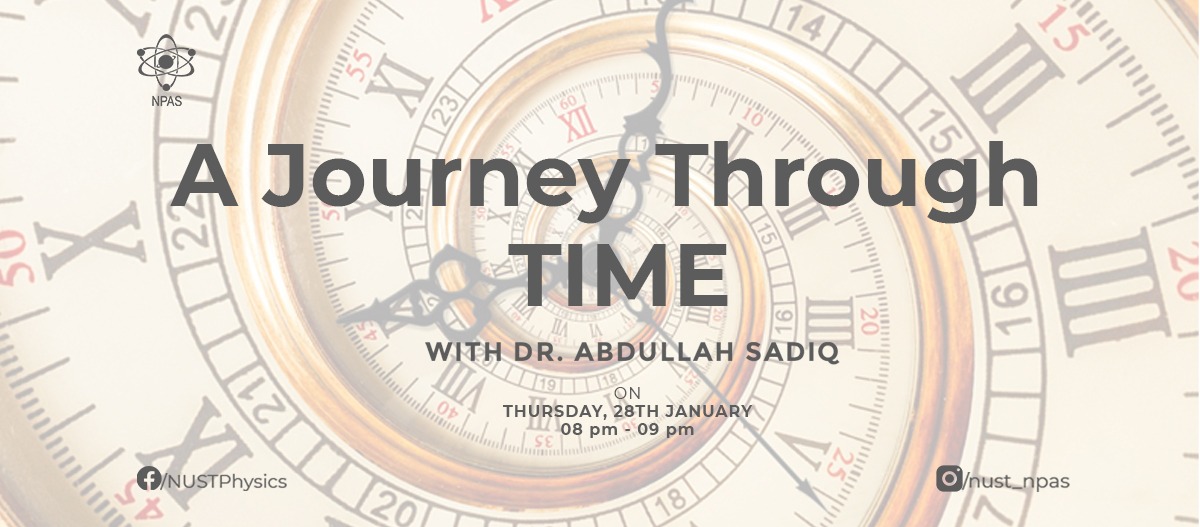
On 28th January 2021, NUST Physics and Astronomy Society (NPAS) hosted the first event of their series “A Journey Through Time” with Dr. Abdullah Sadiq. The event was held online on MS Teams because of pandemic situation and country-wide lockdown. Despite that, it was a major success.
Dr. Abdullah Sadiq – former rector PIEAS and GIK Institute – is a Pakistani nuclear physicist and ICTP laureate who received the ICTP award for his contributions to the field of Mathematics and Solid State Physics. He is an eminent professor of nuclear physics solid state physics in many universities of Pakistan.
The session started off with Dr. Abdullah Sadiq giving insight on physics as a subject. Most people perceive it as a “dry subject”. He told us that the phenomena he observed as a child were related to physics, albeit he did not know it at that time. His inquisitive approach got him into the vast field of physics.
Dr. Abdullah said that he had been profoundly active in lab activities. When asked about the most fascinating experiments and research topics, he mentioned experiments involving Zeeman Effect and Interferometer for studying fringes. He made a breakthrough while studying Spin Glass and Anti-ferromagnetism and related them to a process called Percolation.
“I had a keen interest in optics. I particularly enjoyed using metal salts on flame experiments – sodium produced a vibrant color.”
Throughout his vibrant career, Dr. Abdullah was conferred many awards, the most notable ones being the ICTP Award and Sitara Imtiaz. The International Centre for Theoretical Physics Prize is awarded to honour high-level research.
“It was a pleasant surprise. I was exhilarated when I received the award because it was completely unexpected. I was in Pakistan back then, working in my office one day when I received the letter. I was greatly surprised and immensely happy.”
Dr. Abdullah contributed greatly to research while working for Pakistan Atomic Energy Commission (PAEC). He was given charge of Scientific Information Division (SID), which was the central source of scientific and technical information for PAEC as well as for other scientific programs.
Scope of Physics in Pakistan
“Physics is more than just a career. It is a training that is connected to other disciplines as it provides experimental tools for other domains of scientific research.”
I really loved how Dr. Abdullah tackled the question: “does Physics have any scope in Pakistan. He explained how the invention of transistors revolutionized the realm of Information Technology (IT).
He advised that becoming a successful physicist is predicated on hard work and interest. Interest is the driving force that leads to discoveries. Physics is an extremely vast body of knowledge, so we need to broaden our perspectives. It is essential to create learning spaces for everyone by resourcefully utilizing internet’s virtual libraries.
He answered some interesting queries of curious students. The meeting finally ended as he drew a profound parallel between science and literature:
“Science and literature are profoundly connected. Be it science, literature, arts or any other discipline, all of them have their roots in creativity. It depends on how you pursue them. After all, physics is one such creative activity.”
The event was virtual but the impact it made was real and lasting. It was very thoughtful and stimulating.

 npasofficial.com