Einstein is famous for his saying that God is sophisticated but he does not play dice. Einstein dislikes the probabilistic aspect of quantum mechanics not that he dislike or disapproved the use of probability in physics, his thesis work had been on kinetic theory and statistical physics that means he was quite comfortable with the idea that in classical physics is used, statistical methods to do things like kinetic theory but he understood that the reason we were doing probability theory because we had incomplete information so it is obvious that we have to assign probabilities. The thing worrying for him was the quantum mechanics which asserted that the even we had complete information which is embodied in quantum mechanical wave function, a complete set of amplitudes, still the outcome is probabilistic or uncertain and he felt this was wrong because the omniscient God would not have the future uncertain he would know what the future was so God must know something that we don’t know. We have an uncertain future because we are short of information but the information must be there, we just don’t know the information. There must be some variables which encode the information about what’s going to happen which if we knew them and at some future time in physics perhaps, we would know what these variables were and then we would be able to predict exactly what was going to happen.
EPR Paradox:
In 1935, Einstein with Podolsky and Rosen proposed a thought experiment in which they claim to demonstrate that the wave function of quantum mechanics does not provide complete description of physical reality and hence the Copenhagen interpretation (If two properties are related by an uncertainty relation, no measurement can simultaneously determine both properties to a precision greater than the uncertainty) is unsatisfactory.
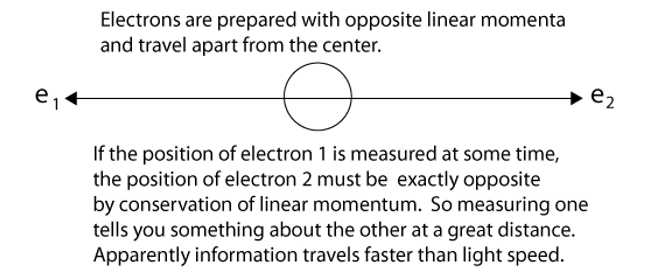
The crux of their argument rested on the idea of a phenomenon in quantum mechanics called entanglement. EPR argued that since nothing can travel faster than light according to special relativity, this should invalidate the Copenhagen interpretation.
Bell’s Inequality:
In 1964, John bell proposed an equation to determine who was right. In a universe where local hidden variables are true, when the two particles are emitted, they know what their state is going to be in all three directions, Z, X, and Q from birth. And there are only 8 possibilities of spins that each particle could have:
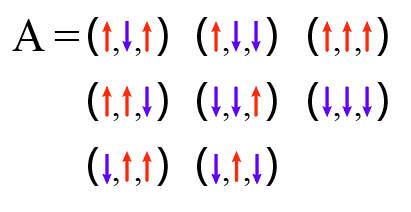
what is the probability that Alice measures in the z direction, gets a positive spin, and Bob measures in the X direction and gets a positive spin? Well, if the above case is for Alice, there are 4 events where Z is positive. In order for Bob to get X positive, Alice would have to have measured X as negative. So these would be in event 3 and event 4. To get the probability we have to divide by the total number of events, 8. Let’s do this for two more scenarios. What is the probability that Alice measures positive in the Z direction, and Bob measures positive in the Q direction? In this scenario, it would be event 2 and event 4. Again we divide by 8 to get the probability. And the third case is: What is the probability that Alice measures positive in the Q direction, and Bob measures positive in the X direction? This would be event 3 and event 7, divided by 8 for probability.
P: Z+, X+ = E3 + E4/8
P: Z+, Q+ = E2 + E4/8
P: Q+, X+ = E3 + E7/8
So these are the three probabilities given the hidden variables theory. Now here is big insight that John Bell had: If I take the total number of Events, and multiply that by the probability that Alice measures Z positive and Bob measures X positive, this has to be less than or equal to the total number of events times the probability that Alice measures Z positive, and bob measures Q positive, plus the probability that Alice measures Q positive, and bob measures X positive.
P:Z+,X+ less than or equal to P:Z+,Q+ + P:Q+,X+
I can prove this is true by doing simple math:
E3 + E4 is less than or equal to E3 + E4 + E2 + E7
This makes total sense, because E3 and E4 are on both sides of the equation. And E2 and E7 have to be positive. So this inequality absolutely HAS to be true for any hidden variables theory to be true. But what happens in a universe where the laws of quantum mechanics are correct, and not hidden variables theory?
And that probability of Bob measuring Q to be positive, after Alice has measured Z to be positive, is given by the following equation:
P: Z+,Q+ = sin^2 of 45 degrees/2
This is the critical difference between quantum mechanics and hidden variables theory. The probability is not linear but looks like sine wave. When you plot this out, this is what the probabilities look like: So you can see from the graph that at 0, and multiples of 90 degrees, the two systems are in agreement. But in between, like at 45 degrees, the probability is 25% for hidden variables, and about 14.6% for quantum mechanics. But the proof is in the pudding, because in test after test, the sine function correlation has been confirmed. The particle does not behave linearly, and so the hidden variables theory cannot be correct. So most theorist do not think special relativity is violated, because we can’t communicate using this seemingly faster than light phenomenon.
Written by: Kuldeep Kumar

 npasofficial.com