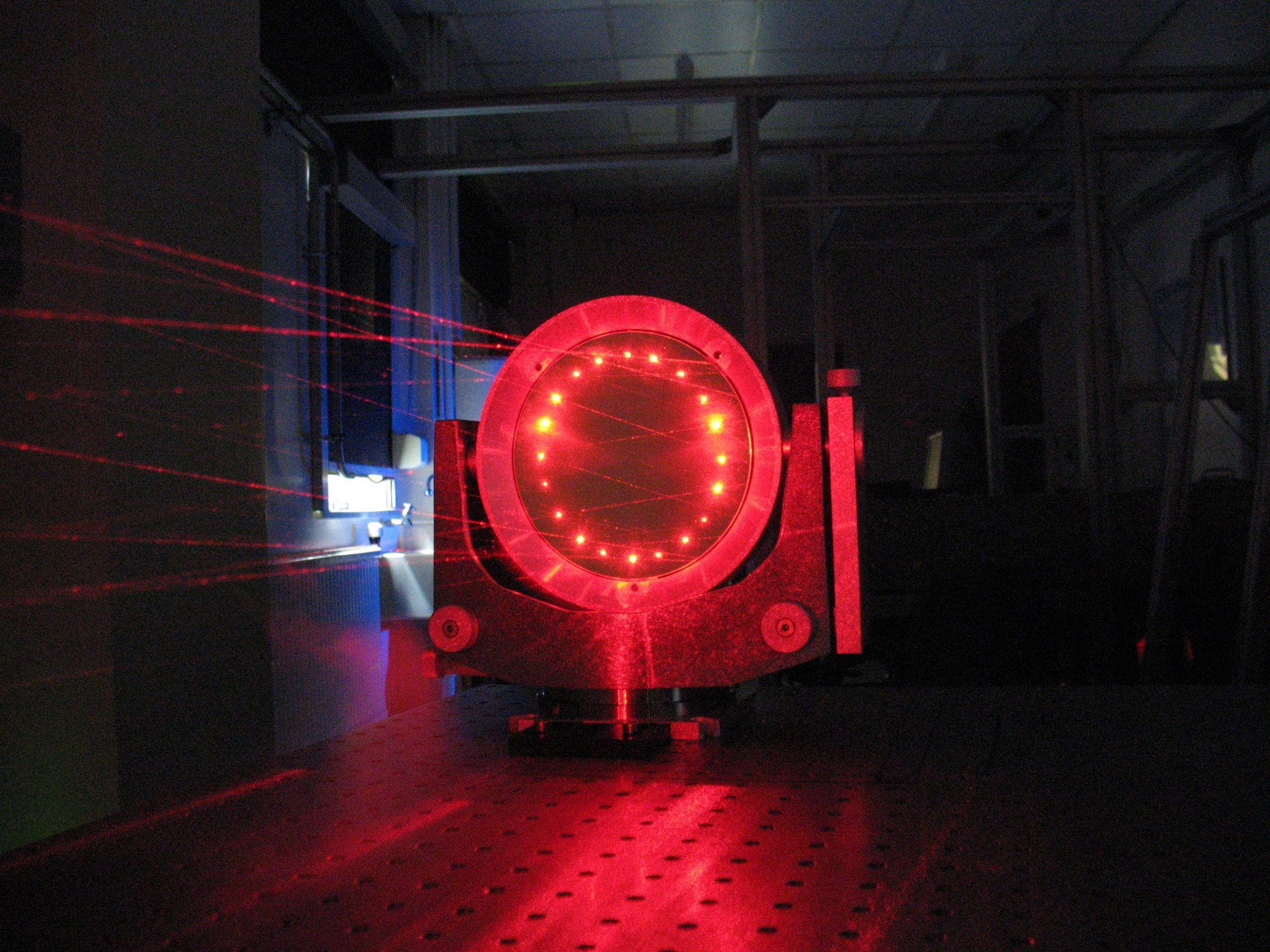
Recently, researchers have discovered that they can control terahertz quantum cascade lasers in such a way that can lead to the transmission of data at the rate of 100 gigabits per second. If this is achieved then it will be almost thousand times faster than a fast Ethernet operating at 100 megabits a second.
Basically, light is emitted in the terahertz range of the electromagnetic spectrum which distinguishes terahertz quantum cascade lasers from other lasers. The terahertz quantum cascade lasers have applications in the field of spectroscopy where they are used in chemical analysis.
The terahertz quantum cascade lasers could provide ultra-fast, short-hop wireless links where large data sets have to be transferred across research facilities on universities or hospital or campuses or even satellite communications.
For the proper working at increased speeds, the lasers need to be modulated very rapidly. This means switching on and off or pulsing around 100 billion times every second. Scientists and engineers so far have failed to develop a way of achieving this. Although a research team from the University of Leeds and University of Nottingham think they have found a way to deliver ultra-fast modulation. They say that it can be done by combining the power of acoustic and light waves. They have published their findings on February 11th, 2020 in Nature Communications.
A professor of Nano-electronics at University of Leeds, John Cunningham, said: “This is exciting research. At the moment, the system for modulating a quantum cascade laser is electrically driven == but that system has limitations. Ironically, the same electronics that delivers the modulation usually puts a brake on the speed of the modulation. The mechanism we are developing relies instead on acoustic waves.”
The reason for choosing quantum cascade laser is that it’s very efficient. As an electron passes through the optical component of the quantum cascade laser, it goes through a series of ‘quantum wells’ where the energy level of the electron drops and a photon is emitted. A single electron is capable of emitting multiple photons. This process is controlled during the modulation. The researchers at Leeds and Nottingham universities have used acoustic waves instead of external electronics. These waves vibrate the quantum wells inside the quantum cascade laser.
For acoustic waves, a pulse from another laser onto an aluminium film creates an impact. This also causes the film to expand and contract, sending a mechanical wave through the quantum cascade laser.
A professor of Physics at Nottingham, Tony Kent, said: “Essentially, what we did was use the acoustic wave to shake the intricate electronic states inside the quantum cascade laser. We could then see that its terahertz light output was being altered by the acoustic wave.”
Professor Cunningham further added: “We did not reach a situation where we could stop and start the flow completely, but we were able to control the light output by a few percent, which is a great start. We believe that with further refinement, we will be able to develop a new mechanism for complete control of the photon emissions from the laser, and perhaps even integrate structures generating sound with the terahertz laser, so that no external sound source is needed.”
Professor Kent also said: “This result opens a new area for physics and engineering to come together in the exploration of the interaction of terahertz sound and light waves, which could have real technological applications.”
Journal Reference: Aniela Dunn, Caroline Poyser, Paul Dean, Aleksandar Demić, Alexander Valavanis, Dragan Indjin, Mohammed Salih, Iman Kundu, Lianhe Li, Andrey Akimov, Alexander Giles Davies, Edmund Linfield, John Cunningham, Anthony Kent. High-speed modulation of a terahertz quantum cascade laser by coherent acoustic phonon pulses. Nature Communications, 2020; 11 (1) DOI: 10.1038/s41467-020-14662-w
Written by: Arsalan Ahmad Arif

 npasofficial.com