Written by Hadee Farhan
Albert Einstein was born to a middle-class German Jewish family. His parents were concerned that he scarcely talked until the age of three, but he was not so much a backward as a quiet child. He would build tall houses of cards and hated playing soldier. At the age of twelve he was fascinated by a geometry book. And from there on the story escalates.
“It is almost a miracle that modern teaching methods have not yet entirely strangled the holy curiosity of inquiry; for what this delicate little plant needs more than anything, besides stimulation, is freedom.”
Albert Einstein’s name has become a synonym for genius: discoverer, educator, revolutionary and creative. From unbreakable scientific theories to persistent cultural icon, his impact on the world is timeless.
A German-born physicist, he changed the world of physics in the early 1900s with his Theory of Relativity, which cracked open the smallestand biggest things in the universe, as well as producing the world’s most famous equation: E = mc2.
His work laid the basis for the release of atomic energy, he accelerated the development of technology and physics like no one since Isaac Newton 250 years previously – and he transcended science. His work impacted philosophy, arts, literature and culture.
Einstein won a Nobel Prize for Physics in 1921 for his explanation of the photoelectric effect, he rewrote the laws of nature, he shifted how the world understood light, gravity and time. And his distinctive look and individuality became iconic.
What stood out was his determination to deconstruct big ideas or concepts and ask simple questions. The Theory of Relativity started with this thought: if you could ride a beam of light, what would the world look like? He said:
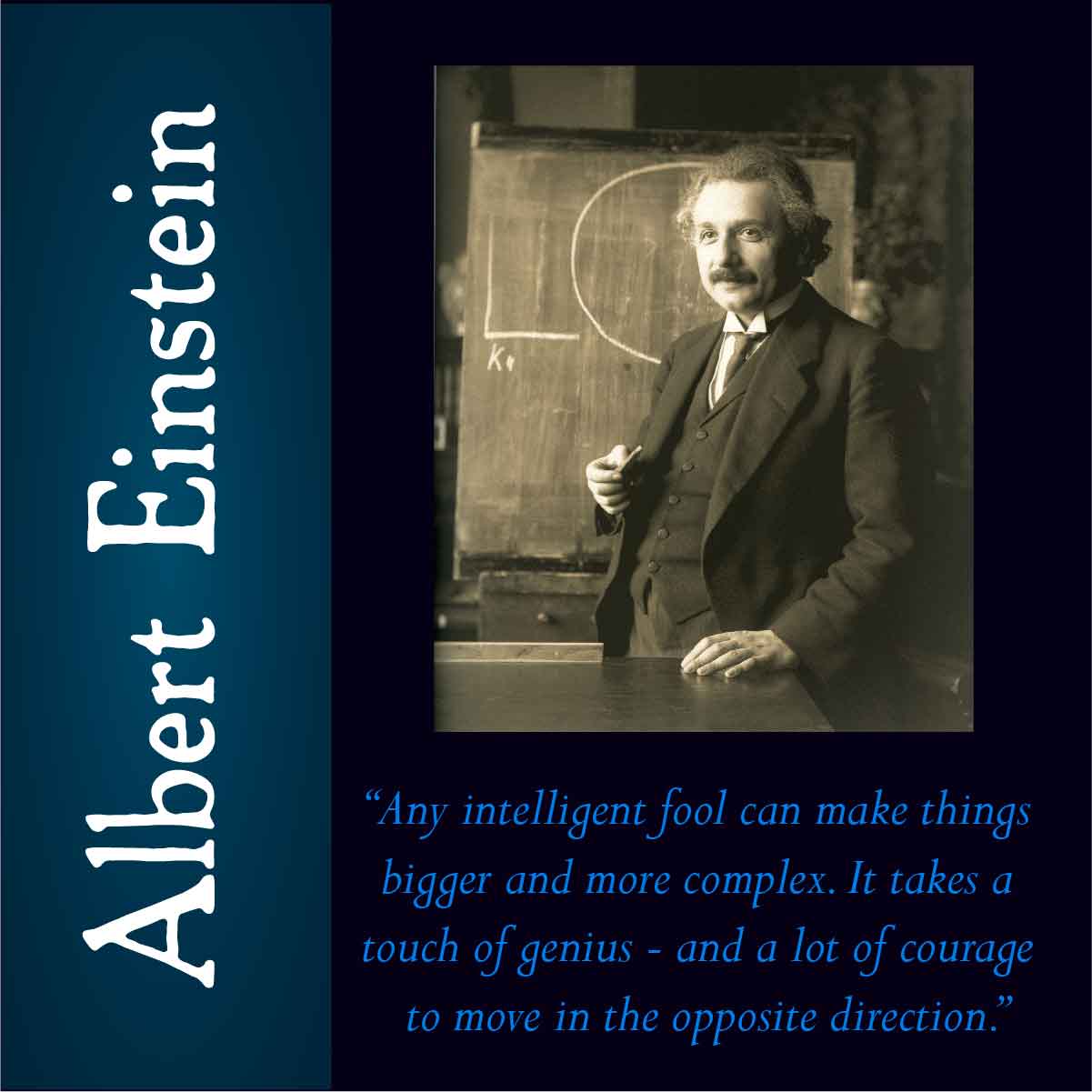
“Any intelligent fool can make things bigger and more complex… It takes a touch of genius – and a lot of courage to move in the opposite direction.”
An unfortunate legacy of the maestro is the use of his research in the development of the atomic bomb. It was his letter to President Roosevelt warning of the German effort to build an atomic bomb that kickstarted the “Manhattan Project”, which ultimately resulted in the Allies acquiring and utilizing an atomic bomb.
No one regretted more than Einstein the close association of his great theory with atomic bomb and instruments of warfare, yet he realized that this was a normal part of human evolution and that man must grow with his universe. His new directions of thought were filled with meaning for the coming races of mankind, and will lead men into new fields of awareness, new challenges of attainment, and new realizations of human destiny.
Einstein died on April 17, 1955 of an aneurysm. Such a combination of intellectual abilities as his comes not more than a few times in a millennium; we are distinguished to have lived while such a giant walked the earth.

 npasofficial.com